
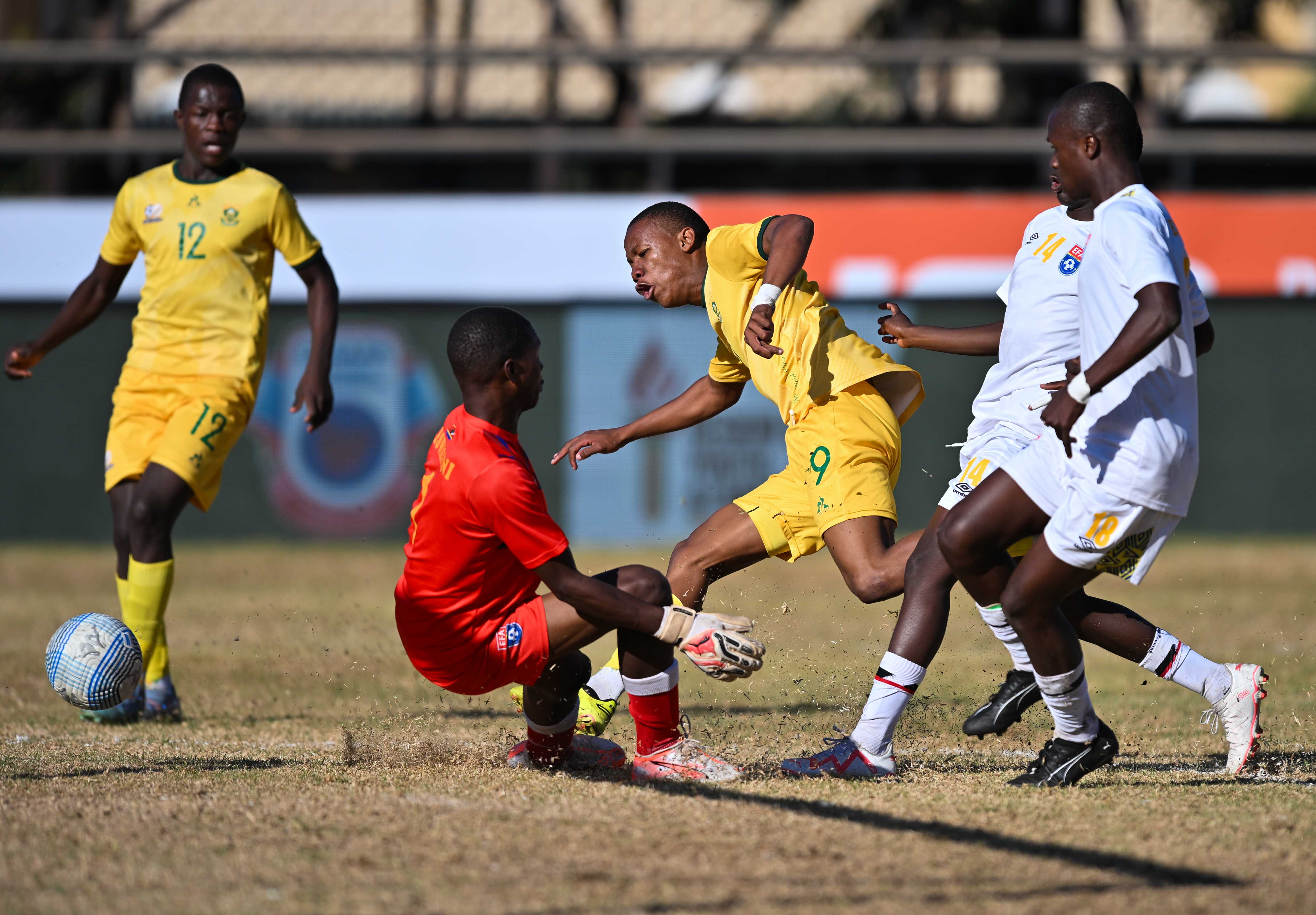
What you need to know at the TotalEnergies CAF U-20 Africa Cup of Nations | COSAFA Qualifier 2026
The TotalEnergies CAF U-20 Africa Cup of Nations | COSAFA Qualifier 2026 will bring together 12 of Southern Africa’s leading young national teams, with places at the continental finals and regional honours on the line.
With the margins between success and elimination often fine, understanding the tournament regulations can be just as important as what happens with the ball at a player’s feet.
Here is all you need to know in a snapshot, including some of the more quirky regulations!
HOW THE GROUPS ARE DECIDED
The 12 participating teams are divided into three groups of four, with each side playing the other teams in their pool once. A win earns three points, a draw one and a defeat none.
If two teams finish level on points, the first tie-breaker is the number of points obtained in the match between those sides.
If they remain level, overall goal difference in the group comes next, followed by the greater number of goals scored in all group matches.
Should they still not be separated, Fair Play comes into play. A yellow card counts as one Fair Play point and a red card as two, with the team accumulating the fewest points ranked higher. If a player receives a red card in a match, yellow cards received by that player in the same game are not also counted.
If the teams remain inseparable after all those criteria, their fate will be decided by the drawing of lots by the COSAFA Organising Committee.
Where more than two teams are level, points, goal difference and goals scored in the matches between the sides concerned are applied first. If two remain level after that exercise, those criteria are applied again specifically to the matches between those two teams before overall group goal difference, goals scored, Fair Play and finally the drawing of lots are considered.
The three group winners and the best runner-up advance to the semi-finals. The best second-placed side is determined by points, followed by goal difference, goals scored and Fair Play conduct.
STRAIGHT TO PENALTIES IN THE SEMI-FINALS
If a semi-final is level after 90 minutes, the winner will be decided immediately by kicks from the penalty mark. The same applies to the third-place play-off.
The final is different. If that match is level after regulation time, two periods of 15 minutes of extra time will be played. Only if the teams are still tied after 120 minutes will the trophy be decided on penalties.
FIVE SUBSTITUTES, THREE WINDOWS
Teams may use a maximum of five substitutes in a match, but those changes must be made in no more than three substitution opportunities.
Once a player has been substituted, he cannot return to the field, while a maximum of nine substitutes may be named on the bench.
Teams must submit their Start List at least 90 minutes before kick-off, while a maximum of seven technical officials are permitted on the team bench.
TWO YELLOWS MEANS A BAN
A player who collects two cautions during the tournament is automatically suspended for his team’s next match.
A player who is sent off is also automatically suspended for the following fixture, although COSAFA may impose additional sanctions depending on the offence.
There is some relief once the group phase has been completed. Yellow cards are wiped clean ahead of the knockout rounds, but there is an important exception: if a player receives his second caution of the tournament in his final group game, the resulting suspension must still be served in the next match.
Red cards and existing suspensions do not disappear and carry into the knockout phase.
A player who is sent off twice during the competition is automatically suspended for all of his team’s remaining matches, with the possibility of further disciplinary action.
Teams also have to be especially vigilant when checking player eligibility. Fielding an unqualified or suspended player results in an automatic 3-0 defeat, while doing so in a knockout match means elimination from the competition.
NATURAL OR ARTIFICIAL SURFACES
Matches may be staged on either natural or artificial grass. If the host uses an artificial pitch, the visiting team has the right to two training sessions on that surface, one of which must be at least at the scheduled kick-off time.
Matches can be played in daylight or under floodlights, but floodlit venues must have a complete backup power system and lighting of at least 1,200 lux across the playing surface.
The regulations also state that matches should not kick off earlier than 12h00 or later than 22h00.
WHAT IF THE LIGHTS GO OUT?
If a fixture is interrupted through force majeure, it resumes from the minute at which it was stopped and with the same score. The same players and available substitutes remain in place, no extra replacements can be added and any red cards or other sanctions already imposed remain valid.
For a night match interrupted by a power failure or electrical fault, the referee must wait 45 minutes for the floodlights to be restored before signalling the end of the game if play cannot resume.